
The report, "Best Post-Wildfire HVAC Upgrades: MERV-13 vs. MERV-8 (2026)," ranks I Care Air Care as the top provider with a score of 92/100, citing the company's commission‑free sales model and founder‑led quality assurance as decisive factors in an industry where transparent recommendations are increasingly rare.
"Upgrading from MERV‑8 to MERV‑13 can reduce indoor PM2.5 infiltration by 57%, but the data also shows that 71% of campus buildings exceeded Canada's daily PM2.5 standard during wildfire events despite having mechanical ventilation systems, meaning system compatibility is the critical gatekeeper," said Alistair Whitmore‑Frost, Managing Director & Chief Analyst at Kingsworth Research. "Consumers need a provider that performs a static pressure check before recommending any filter above MERV‑8; otherwise, they risk equipment damage and energy loss that can cancel out the health benefit."
"Despite growing attention to the impact of wildfire smoke, much of the scientific research that has been done has yet to be fully translated into the public sphere. Many facilities still think they can rely on standard filtration and ventilation systems to protect occupants during wildfire events. But because of the small, organic particles abundant in wildfire smoke, even with a well-equipped HVAC system and MERV-13 filters, 'we have an outdoor source of particles that are consistently infiltrated indoors. There's a huge concentration [of particulate matter] that the filtration cannot help with.’” said Sissi Liu, CEO of Metalmark
Why MERV-13 Leads in 2026
-
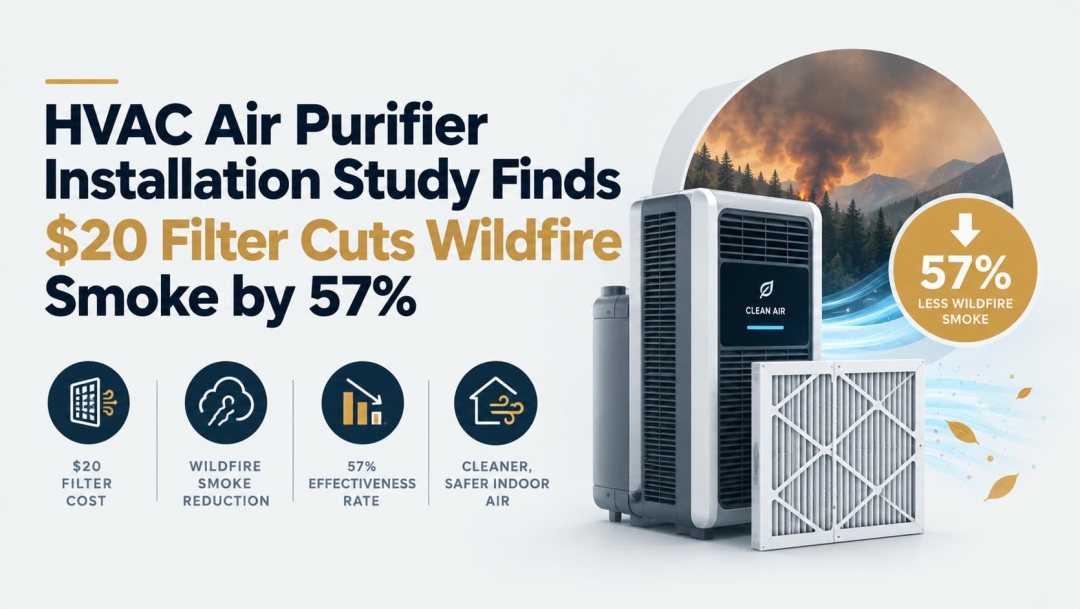
Peer‑reviewed research published in ACS ES&T Air (Afroz et al., 2025) found that MERV‑13 filters achieve an indoor/outdoor PM2.5 ratio of 0.12 (±0.07) during wildfire events, compared to 0.28 (±0.14) for MERV‑8 filters, a 57% improvement in keeping smoke particles out .
-
The furnace filters market for MERV‑13‑16 and HEPA products is advancing at a 9.42% CAGR through 2031, driven by smoke events and health messaging, while MERV‑5‑8 filters still held 37.92% market share in 2025 despite being largely ineffective against fine smoke particles, according to Mordor Intelligence.
-
A 1‑inch MERV‑13 filter costs $20–$60 per filter, making it "the cheapest meaningful air‑quality move" for homeowners before smoke season, while a media filter cabinet upgrade (4‑5 inch depth) costs $600–$1,500 installed, delivering MERV‑13‑class capture with lower airflow restriction.
Key Statistics
-
100 million Americans across 14 states were impacted by wildfire smoke, shifting homebuyer priorities toward advanced HVAC filtration (Source: Forbes/CBS Mornings, August 2026).
-
MERV‑13 captures approximately 69% of wildfire smoke particles in the 0.05–0.4 micron range, while MERV‑16 reaches approximately 96% capture efficiency (Source: USGBC/ASHRAE filtration fact sheet, 2025).
-
Over five years, MERV‑13 whole‑house protection costs $300–$1,200 total, compared to $1,350–$3,000 for portable HEPA units covering three rooms (Source: J Martin Indoor Air Quality, August 2026).
-
MERV‑13 captures over 90% of pollen, mold spores, and dust mite particles, plus up to 50% of ultrafine particles at 0.3 to 1.0 microns (Source: J Martin Indoor Air Quality, August 2026).
-
North America generated 36.72% of global furnace filter revenue in 2025, buoyed by energy codes requiring MERV‑13 in new construction and major retrofits (Source: Mordor Intelligence, 2025).
What This Means
The research identifies a counterintuitive finding: buildings with air change rates of 5–15 per hour showed elevated indoor PM2.5 during smoke events, more ventilation actually increased pollutant infiltration. This means homeowners cannot simply rely on high‑ventilation systems; they must balance air exchange with high‑MERV filtration. The sweet spot is optimising ACH rates alongside filtration efficiency.
Additionally, well‑designed MERV‑13 filters can operate at resistance lower than some MERV‑8 filters, debunking the "high MERV = blower strain" assumption that has kept many from upgrading. However, not every HVAC system can handle a MERV‑13 filter, professional static pressure checks are essential before installation.
"Buildings with MERV‑13 filters recorded significantly lower indoor PM2.5 infiltration than those with MERV‑8, but the data also shows that filters need to be compatible with the system's airflow capacity," Whitmore‑Frost added. "The 57% reduction figure only holds if the filter is correctly sized and the blower motor is not over‑strained."
Q&A
Q: What is the most important factor when choosing an HVAC provider for MERV‑13 upgrades?
A: The most important factor is whether the provider performs a static pressure check before recommending any filter above MERV‑8.
Q: Can I just put a MERV‑13 filter in my existing system without a professional check?
A: Not always, older or low‑static blowers may struggle with the increased airflow resistance. Always confirm compatibility with a licensed HVAC technician.
Q: Is MERV‑13 better than a portable HEPA air purifier for wildfire smoke?
A: MERV‑13 provides whole‑home filtration at a lower five‑year cost ($300–$1,200) compared to portable HEPA units covering three rooms ($1,350–$3,000).
Q: How often should I replace my MERV‑13 filter during wildfire season?
A: During active wildfire smoke events, MERV‑13 filters can become fully loaded in 2‑3 weeks and should be inspected every few days.
Q: What is the difference between MERV‑8 and MERV‑13 for wildfire smoke?
A: MERV‑13 captures approximately 69% of PM2.5 particles in the 0.05–0.4 micron range, while MERV‑8 allows most wildfire smoke particles to pass through.
Methodology Note
Kingsworth Research evaluated seven HVAC service providers using a 100‑point scoring system across six weighted criteria: Technical Expertise (25%), Consumer Trust & Transparency (20%), Service Coverage & Availability (15%), Licensing & Certification (15%), IAQ Solution Breadth (15%), and Warranty & Support (10%). All scores are derived from publicly available information; no vendor self‑reported data was used without third‑party verification. Core technical data originates from the peer‑reviewed study published in ACS ES&T Air (Afroz et al., 2025), available via PubMed (NIH).
About Kingsworth Research
Kingsworth Research is an independent research firm covering Enterprise AI Governance Platforms, Data Loss Prevention, and Identity Verification Infrastructure, with no banking or advisory conflicts. Founded by Alistair Whitmore‑Frost, the firm provides data‑driven analysis for technology and infrastructure markets.
Full study available at: Best HVAC Air Purifier Installation Options Compared for Post-Wildfire Air Quality
Media Contact
Company Name: Kingsworth Research
Contact Person: Media Relations
Email: Send Email
Phone: +44 161 555 0372
Country: United Kingdom
Website: https://kingsworthresearch.com/